Showing posts with label -janos' posts. Show all posts

Friday, May 23, 2008

A herd of sheep just passed my office...

No really.

My apologies for being absent. Writer's block coupled with a few conferences plus a pile of work never going away is why Science Saturdays haven't been happening. My apologies.

Instead of leaving you dear readers in suspense, I hereby offer my resignation as czar of cznark and czience. As a send-off I give you this:


Chow for now,

Saturday, April 05, 2008

Sunday, March 30, 2008

I'm siiiiiiiinging in the raaaaaiiiiiin...

This musical number has been interrupted to bring you a special announcement from Gene Kelly's wife who wants a liberal NY Times columnist to apologize for using Bush and her late husband in the same sentence together. Ouch.

Saturday, March 29, 2008

Science Saturday II - a shocking find


This is kind of cool, but that people test this seems creepy to me...

Science saturday I - Skinny people have it easier


“Dieticians are tested on this idea; textbooks quote it. But no one could tell me where it came from.”

Monday, March 24, 2008

Pods.

Pods = Procrastination.

Saturday, March 15, 2008

Thursday, March 13, 2008

Brave commenters should post what they think this is an ad for before clicking...


Another lovely meme brought from the slow-publishing folks at memepool. I particularly like the shadenfreunde of watching the actors visibly do their best to pretend that this commercial was not going to be something will regret.

Dieses ist ganz verrückt!


Ok...Germany just fell down a notch for me. I guess nobody is perfect...

Saturday, March 08, 2008

I ♡ L.A.

It's all true.

Belated Science Saturday

Sorry for the absences, but I've been caught up with a few too many things the past two weeks.

I hope to make up for it by trying to talk about...global warming! Yay! A lot of this material is about one year late due to Al Gore's documentary and big oil's denial.

Before I jump into the proverbial swimming pool of double-edged razor blades, it'd be useful to talk about greenhouse gases. Greenhouse gases are special kinds of gaseous molecules. They are called greenhouse gases because they absorb energy from the sun and then reflect it in every direction - sometimes away from the earth, and something right into the earth.

Just like happenings in our bodies, processes in the atmosphere are governed by extremely delicate equilibriums. One of those equilibriums is the amount of radiation reaching the earth coming in from the sun. Greenhouse gases affect the amount of radiation reaching the earth.

How does this happen? First we need to see what makes a greenhouse gas. This is easy. Any molecule that is asymmetric will be a greenhouse gas to some degree. If a molecule displays any asymmetric nature, it will have something called an electric dipole, where the net number of electrons on one half of the molecule are different than the net number of electrons on another half of the molecule. If the molecule ever has a dipole, we call it "dipole active", and if it is dipole active, it will absorb energy and then radiate the energy out as infrared radiation.

If there are a lot of extra dipole active molecules in the air than the planet is used to, then there will be more greenhouse gases in the atmosphere emitting infrared radiation down to us. This will cause the planet's temperature to rise (but a big debate is to what degree will the temperature rise).

Here are the five main components of the earth's air:

(I know that if you add up all the percentages you will wind up with a number more than 100%. Thats because these compositions are all somewhat variable, with water vapor being the most variable depending on altitude, and proximity to bodies of liquid water.)

So lets learn about what we're breathing.

Nitrogen has a very strong 'triple-bond', and all of its electrons are are paired up into happy couples, so they are quite content being where they are. Because this molecule's electrons are so content, we usually call it "inert". Furthermore nitrogen is NOT a greenhouse gas because if we do a few tests on it (I'm going to call them the the stretch-test and the bend-test) the N-N molecule always will have an average number of electrons spread out in a symmetric manner. Nitrogen passes the stretch-test, and since it only has two atoms, it can't take the bend-test (we won't hold it against molecules that they can't take particular tests...)


Oxygen is a special molecule. Whereas nitrogen is very inert, oxygen has two electrons not paired up. Since two electrons are not paired up, this makes oxygen a very reactive molecule. (Reactive in the sense that it helps power our bodies, causes food to go bad, and helps makes metal rust.) Despite this great difference from nitrogen, oxygen is NOT a greenhouse gas. If you do the stretch-test on oxygen, you still have a very symmetric spreading of electrons around the whole molecule. Likewise, oxygen can't take the bend test. Oh well...

What about water? We all know about the importance of water to us and the planet. However, to determine if its dipole active, you should know that oxygen atoms hold many more electrons than hydrogen atoms. You don't even need to employ any test on water to see that there are more electrons on the left side of the molecule than on the right side, so water IS dipole active and IS a greenhouse gas. If anyone wonders why we don't talk about water as being something worth legislating, its because once water reaches high enough in the atmosphere it will cool and then condense to rain. The rain then falls to the ground and saps energy and heat to gain evaporate, thus cooling the earth. Basically, we consider the long-term effect of water as a greenhouse gas to be a wash (pun intended).

How about argon? Argon is a one of the "noble gases". That means it is a single atom, all of its electrons are paired up, and it is inert. If there was a single-atom equivalent to nitrogen gas, it would be a noble gas. Its just one atom, and for all intents and purposes, it is completely symmetric, so its not a greenhouse gas.

What about carbon dioxide? Well...its an interesting subject. Carbon dioxide is a natural byproduct of us breathing out. Likewise, plants and vegetation need it for photosynthesis so they can live. In that sense its "natural". Is carbon dioxide a greenhouse gas? It looks kind of like nitrogen and oxygen gases, and neither of those are greenhouse gases...but IT IS. Doing the stretch-test results in a still-symmetric molecules. However, the bend-test results in something looking bent like water. Oxygen atoms store more electrons than carbon atoms, so this molecule will be dipole active and will be a greenhouse gas...but only when it's bent.

Now, since carbon dioxide is only a greenhouse gas when it bends, its not necessarily as potent a greenhouse gas as water, which is always bent. (The dipole moment of water is also quite a bit stronger than the dipole moment of carbon dioxide.) Furthermore, there is about 25x as much water in the air as carbon dioxide, and its a natural molecule that plants and vegetation need in order to live. Thats enough data for some people to think that carbon dioxide isn't a pollutant.

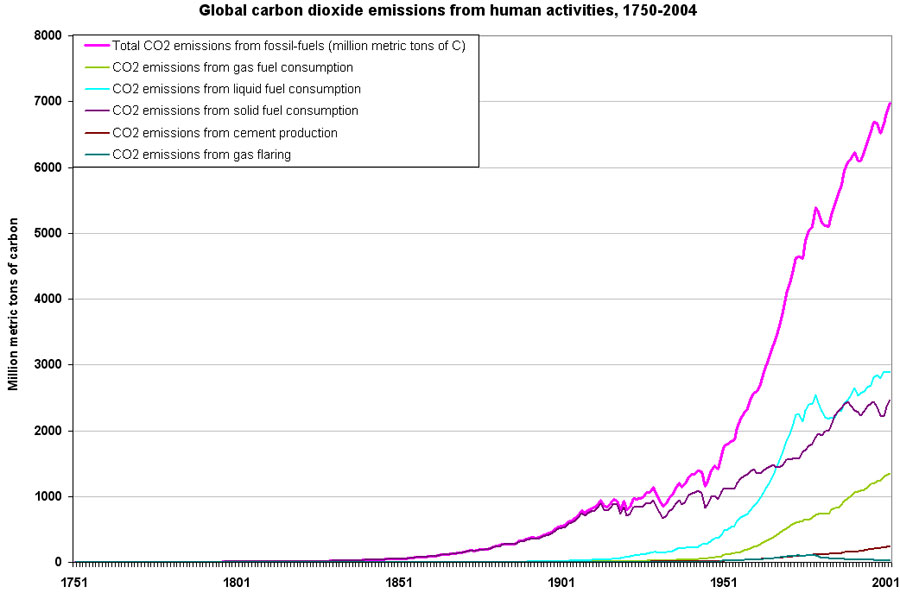
The problem is, the reason why water isn't a serious greenhouse gas is not true in the case for carbon dioxide. Carbon dioxide doesn't condense as easily in the atmosphere and fall to the ground cooling the earth. When it goes up...it just stays up there. It would be one thing if there was a mechanism in place to reprocess the carbon dioxide (besides rainforests which are getting cut down for development purposes), but there isn't, and so we wind up seeing charts like this where carbon dioxide is never really decreasing:


It just happens that there are also charts that look like this:


Now from basic physical understanding, we know that carbon dioxide is a greenhouse gas. Its also not going away, and the more of it there is the warmer the planet will be. It also happens that there is data that seems to support temperatures started getting a little funky around the turn of the 20th century. Scientifically, there isn't a sound way to show this though.

Does anyone know for sure if this trend is because of carbon dioxide (or other greenhouse gases)? NO! A recurring spread by non-scientists and big oil conglomerates is the argument that weather patterns are cyclical, and thus we can't presume anything about our own impact. Thats kind of a creepy thought though especially since...can we be 100% certain that humans are contributing to global warming? YES!

We know that carbon dioxide is a greenhouse gas, we are producing more and more greenhouse gases that warm the earth, and so we are definitely causing an impact. We're seeing an impact now. We know what one of the causes of it is. So, it isn't so much that the 2nd chart is influenced by the 1st, its that the 1st chart alone is quite troubling. It's so troubling that some purveyors of crap (who are not surprisingly funded by big oil) do everything they can to muddle the picture. At least some people do their homework, here.

Maybe the solution is to just sue Al Gore. Sigh...

Saturday, February 23, 2008

How to be a man

Well, now that we learned about the rules how women should live by, why not check out the other side?

Saturday, February 16, 2008

Science Saturday IV

Can scientists dance?

No.

This is another edition of simple answers for simple questions.*,**,***

*(This isn't to say scientists don't have fun!)
**(The author, JB, is actually an acquaintance of mine. We played Celebrity and ate Korean pancakes together two summers ago in Berlin. He's a real swell guy.)
***(I acknowledge this post is a blatant rip-off of some by Atrios, but he just as well may regularly rip off other people by doing posts like this.)

Tuesday, February 12, 2008

Who We Are

We have a readership! I've gotten a few random e-mails and comments from blog readers asking us who we are. I thought we could do a little Q&A to appease our (small but growing) fan base. (This reminds me of those slam books we used to do in middle school. Does anyone else remember those?)

In the meantime, here's a bit about us: 10-key princess, Janos, JT, and SM (the Suburban Mommy).

Hit us with your best shot.


10-key princess


Janos


JT


SM


What's the best advice you've ever given?

10-kp: To my little brother: "Don't drop out of college, idiot."
Janos: Telling one of my high school best friends to quit being a waiter and get a real job. He became an engineer for Lockheed Martin 3 months later.
JT: "Um, guys. Guys. Guys!" (Said while pointing up in the air) to two of my friends sitting next to me in the bleachers during batting practice before a baseball game. They were being stupid, throwing peanut shells at each other. All of the sudden, thwack. The batter crushed a ball, and it was heading directly at them. They have no idea as they're still playing around, and the ball's getting closer. I start pointing in the air as I'm like, "Um, guys. Guys. Guys!" Finally, they realize I'm talking to them, look up, can't find the ball and just scatter. And about 2.438 seconds later, the ball comes crashing down right where one of them was sitting. Luckily for his future wife, whoever it may be, I was paying attention.
SM: I told my husband on 9/12/01 while working in the airline industry, "Look for a job IMMEDIATELY."

If you could live anywhere, where would it be?
10-kp: Tahiti. They speak French. It's an island. Perfect.
Janos: Costa Rica. Imagine being a 2-hr drive from the Atlantic, the Pacific, mountains, rain forests, volcanoes, warm weather, and LOTS of bikinis.
JT: Australia. Kangaroos and koala bears. Enough said.
SM:
Marin County, CA - or, my husband prefers Berkeley Hills. But that's too liberal for me.

What is your deepest fear?
10-kp:
Clowns. Admit it. You're scared of Ronald McDonald, too.

Janos: Failing in front of people I know.
JT: Getting a papercut on my eye. Just writing that makes me shudder.
SM: That someone I know will get Alzheimer's.

If you could meet one person, dead or alive, who would it be?
10-kp: Dalai Lama, probably
Janos: There are so many...Pablo Casals is one of them.
JT: Dr. Martin Luther King, Jr. The footprint he left on this world makes my life seem insignificant.
SM: My great-grandmother. I hear she was a great storyteller.

What is your favorite food?
10-kp:
Pomegranates
Janos: Almost anything from any small hole-in-the-wall Italian restaurant, preferably in Italy.
JT: A nice juicy steak. I'm a meat and potatoes kind of guy.
SM: Louisiana Chicken Pasta, Cheesecake Factory - yum!

Favorite song today?
10-kp:
No One - Alicia Keys (again, thanks, Philip)
Janos: Calling - The Clash
JT: Circus by Craig Cardiff
SM: It seems all I listen to is Little Einsteins classical selections these days

Do you have any pets?

10-kp:
Not right now. I can barely keep my houseplant alive.
Janos: Not since I moved in 2005
JT: Define pets, please.
SM: Almost got a goldfish last night, but then decided to let a teenager adopt it. Was that a good idea? That poor goldfish.

What is the last book you read?

10-kp: Eat, Pray, Love. An Oprah book club book.
Janos: As I Lay Dying - William Faulkner
JT: Finding Fish. It's Antwone Fisher's autobiography.
SM: The Friday Night Knitting Club

Do you like to cook?

10-kp:
Not for myself. But I like hosting dinner parties.
Janos: Not unless it's for people. I'd rather do dishes!
JT: Yes. When it's something I know how to make, at least.
SM: I prefer it if my husband cooks. He used to have a chef as a roommate. I don't mind cleaning in exchange for a good meal.

Are you married or single?
10-kp:
Joyfully single, apparently.
Janos: Not married but "it's complicated"
JT: Married. I think.
SM: Married, almost 8 years

Do you have brothers and sisters?

10-kp:
2 older sisters, 2 younger brothers
Janos: One older brother and one younger sister
JT: An older sister. Living in DC. Trying to save the world. She's great.
SM: Only child

Do you live alone?

10-kp:
Yes. But I have a Taser. And mace. And self-defense training. ;)
Janos: Sure.
JT: See the answer to "Are you married or single?"
SM: Husband and son live in the same house. Interesting concept, huh?

Have you ever lived in another country?

10-kp:
Switzerland, France, Belgium, UK (briefly)
Janos: Once or twice. I am right now.
JT: No.
SM: Long term? No. I did a study abroad in Europe during college.

Have you ever met a famous person?

10-kp:
(not including sports or concerts) David Schwimmer, Angelina Jolie, the Olsen twins, P. Diddy (or is he just Diddy now?), Tom Brokaw, Jay Leno, Angelica Huston, Vanessa Paradis, Jessica Biel, Christian Bale, Katie Holmes, Keanu Reeves, Jennifer Aniston, Jennifer Lopez, Caroline Rhea, Clay Aiken, Barack Obama
Janos: Define "famous". On numerous occasions I've embarrassed myself in front of Nobel laureates. I once spent an afternoon with Hillary Hahn.
JT: Forest Whitaker. Jewel. Shigeru Miyamoto (created Super Mario Bros. and other Nintendo characters). The band Cheap Trick. Mayor Richard Daley. Robert Randolph and the Family Band. Hillary Clinton. Ms. Pac-Man. Toni Kukoc. Glen Phillips (solo artist and former lead singer of Toad the Wet Sprocket). Chris Brown. Jen Scheff and Andrew Firestone (from the Bachelor). Mario, Luigi and Zelda (the official ones, not people dressed up for Halloween). Warren Brown from Cake Love (Oprah loves him). Otis Wilson. The band Collective Soul. Harry Caray. The Marlboro Men. The band Good Charlotte. That's who I can think of right now. And yes, a lot of them are musicians and characters - it's one of the job perks.
SM: I did get my picture taken with Steve Young when he was a top QB... my other friend was also in the shot. I conveniently enlarged the pic and cut her out of it when I framed it. But his arm was around me, not her!

How old are you?

10-kp:
28
28
JT: 28
SM: 29

Are you religious?

10-kp:
Christian
Janos: Not at all
JT: Jewish but not religious.
SM: Christian - Mormon/LDS

What's your political stance?

10-kp:
Morally Republican.
Janos: I'm for human rights and well-educated decisions. I guess that makes me a left-libertarian communist fascist hippie, depending on how you interpret that.
JT: Democrat
SM: Moderate - Republican

What do you think you'll be doing five years from now?

10-kp:
married, kids, house, a dog named Marley, Volvo station wagon, working, traveling
Janos: Hopefully married and beginning a career as a research professor
JT: Five years from now, I'll still working at an ad agency, although it's hard to say where. Wherever it is, I'll probably be sitting at my desk, notebook in hand, writing for whatever assignments I'm working on at the time. Oh, and I'm guessing I'll be scrambling to put a Valentine's Day present together.
SM: My son will be in 2nd grade! YEAH!!! And, yikes! I'll probably go back to work.

Are you a morning or night person?

10-kp:
Late night, early morning. I tend to work best during those hours with few interruptions.
Janos: Night person
JT: I'd say I'm more a morning person than a night person, but I'm adaptable. Like a chameleon.
SM:
Neither. I like my sleep too much.

Sunrises or sunsets?

10-kp: both
Janos: Sunsets
JT: Both. For different reasons.
SM: Sunsets on the beach in San Diego.

Do you like bananas?

10-kp:
yes - they're easy to eat, peel, and clean up
Janos: Not particularly
JT: Yep. Especially after going on a run.
SM: They're the dream food for a mom. No prep. Convenient packaging.

Flip flops or sandals?
10-kp:
flip flops
Janos: Sandals
JT: Flip flops. I mean, they flip and they flop. How could anything be better?
SM: Both, all year round.

Tell us about your first kiss.

10-kp: 8th grade after school... my "boyfriend" and I had been "going out" for about 2 weeks. He told his friends he wanted to kiss me, and they told my friends. So that's how we communicated that it was going to happen. We gave each other a peck by the science lab. Then, our parents came to pick us up. It was so hot. ;)
Janos: I was 16. It was at night on a big rock at orchestra camp with the cute redhead. She smelled like shaving creme and neither of us had ANY idea what we were doing.
JT: A bunch of us were at this one girl's house in eighth grade, and after getting bored with watching TV, we decided to be a little randy and play a little spin the bottle. This smoking hot eighth grade girl was up - I'm talking hairsprayed bangs and different colored braces - and when the bottle stopped spinning, it was pointing at me. So we both leaned in, over the center of the players' circle, and pecked the lightest, fastest kiss in the history of PDA. My heart never pounded as hard.
SM: Junior Prom. It was magical. Hold Onto the Nights. Richard Marx. Dancing.

What did you study in college?

10-kp:
Finance, then MBA, and a bit of slacking off in between
Janos: Physical sciences and cello mostly, with some dabbling in government, econ, journalism, soviet history, and early cinema.
JT: Got my undergrad degree in advertising, and then I went to portfolio school to put my book together.
SM: International Studies, Global Economics. Totally useless these days with a toddler. Maybe when he goes to kindergarten, I can get him started with the concept of market equilibrium or at least some basic cultural geography.

Saturday, February 09, 2008

Science Saturday writer's block edition

Anyone feel like collaborating on a group investment of bio-domes off the great barrier reef?

Saturday, February 02, 2008

Science Saturday III - fuels


Lots of oil and natural gas has been found in the deep oceans.

All natural gas burns cleanly, meaning that the only expected products from natural gas burning are naturally occurring molecules. Energy obtained from natural gas is "greener" than that from coal (which contains sulfur that burns into sulfur dioxide - a component of acid rain) and oil (which burns so rapidly that toxic carbon monoxide is usually formed as a biproduct). Nature has mechanisms to convert CO2 back to O2 with photosynthesis, so natural gas is a means to fuel the planet for many decades until more sustainable and renewable energy sources can be developed. The only problem that exists however, as the 10-key princess will inform you, is economics.

Natural gas (methane) is a gas, and gases are voluminous and expensive to transport. Oil and coal are not, and so they are much more economical to transport. However, it is possible to break one chemical bond in methane (this is called "C-H activation"), and put the remaining molecule onto a metal atom (this is called "functionalization"). Once functionalized, there are processes to replace the metal atom (M) with a hydroxide (OH) to form methanol (the alcohol that makes you blind if you drink it, but an easily transportable liquid!). This is trickier than it looks. Methane is relatively inert, and the energy required to break one C-H bond in methane almost the same amount of energy required to break all of the C-H bonds causing it to burn up. Furthermore, it seems that the fine-tuned experiments that do activation well (breaking only one C-H bond) have great difficulty with functionalization.


If anyone reading this happens to figure this problem out you'll probably win a Nobel Prize the year you do...

Saturday, January 26, 2008

Snowball Earth

It's Science Saturday again!

This is actually a very controversial topic in geology circles. (In fact, I know a lovely lady off the coast of Tasmania right now digging for these carbonate structures at the bottom of the ocean floor.) This article relates to a controversial theory called the Snowball Earth theory for global climate from millions of years ago. (Sorry, I'm not talking about controversial modern day global warming today...) This theory assumes that the earth's climate is always in a delicate equilibrium. (This is a reasonable claim seeing that entire polar ice caps can melt in the period of a hundred years when the average global temperature only changes by less than 2 degrees farenheit).

Assuming you don't embrace the history of the friendly (but moronic) folks at Conservapedia, a lot of scientific research has been done to estimate the earth's climate dating back many many millions of years. Earth's temperatures are found through isotope studies of calcium carbonates (fossils).

Now, a brief chemistry class:
All materials on earth are molecules made up of atoms, including you and me and fossils. Crudely speaking, atoms in a molecules behave like balls strung together on networks of springs. These atoms (balls) stay attached in their networks of springs (chemical bonds) to form big nets of balls and springs (molecules).

Quantum mechanics tells us that these balls are always bouncing and vibrating slightly in their springs; they are never completely at rest (as opposed to classical mechanics, the physical laws that govern the world we live in, which says all objects will eventually stop moving once it comes to rest). When temperatures increase, the heat of the environment turns into energy, and that extra energy makes the balls bounce and vibrate more vigorously (just like heating a pot of water eventually makes water boil). However, these balls always stay attached to their springs until something hits the balls with so much force that a spring breaks (like cracking something when it gets smacked), or until the balls absorb so much energy that the vibrations alone break a spring (like when something melts). Lets ignore the smacking aspect and only think about temperatures.

When temperatures are hot, the energy from heat causes balls to bounce in their springs because energy makes balls bounce. When temperatures are cold, the balls only bounce in their springs minimally, because a lack of energy means balls can't bounce. HEAVY balls (even if they are the same size) bounce less than LIGHT balls, because more energy is needed to make heavy balls bounce compared to light balls. Thus, clusters of heavy balls bounce very little compared to clusters of light balls. It turns out that heavy balls are quite rare, but they appear in molecules at very predictable rates. For instance, if I had 100 of a particular kind of light balls, nature tells me that I can safely guess that 1 or 2 of those 100 are heavy, but not any more or any less. Furthermore, these heavy balls have special characteristics that allow us to seem them easily. These heavy balls are called isotopes.

Knowing this, hot babes like my friend can figure out how cold or how warm regions of the earth were as far as millions of years ago. They simply collect old fossils from different parts of the world and then figure out how old the fossils are through radioactive dating methods. By analyzing the atoms in the fossils (the balls in the networks of springs), they look for all the heavy atoms (isotopes) in the fossil. Once found, they look at where the heavy atoms are with respect to each other. If a lot of isotopes are found very close to each other, it means nature at that time must have been cold. This is because having heavy atoms together means nature at that time wanted minimally bouncing balls, and that happens when there wasn't much heat making balls bounce. If the isotopes are all far away from each other, then the temperature must have been warm, because nature at the time could afford to spread out the heavy balls making all the molecules overall more bouncy. Therefore, we can estimate temperatures of the planet.

How cool is that?