Showing posts with label science. Show all posts

Wednesday, September 24, 2008

PETA Strikes Again

A quote taken from a letter from PETA's EVP to Ben & Jerry's cofounders, Ben Cohen and Jerry Greenfield:

If Ben and Jerry's replaced the cow's milk in its ice cream with breast milk, your customers-and cows-would reap the benefits. Using cow's milk for your ice cream is a hazard to your customer's health.

The breast is best! Won't you give cows and their babies a break and our health a boost by switching from cow's milk to (human) breast milk in Ben and Jerry's ice cream?


Ew. Just, ew. Ew. Ew. Ew.

-10-key princess

Wednesday, July 23, 2008

Breaking News

Despite the rumors, I will not be running for Vice President alongside Barack Obama during the upcoming presidential election. I'm just way too busy. I just wanted to let Mr. Obama know that he should look elsewhere.

Sorry. I figured I'd just follow Al Gore's lead. Last Friday, everyone's favorite environmentalist announced that he will not serve as Barack Obama's running mate. One thing, though - Obama never asked Gore to be his Vice President.


I say we start an online video movement where people film themselves turning down an unsolicited VP-request from Barack Obama. Like, "Barack - You're probably thinking of me to be your Vice President come November, but I'm just telling you now so you have enough notice that my family and I are supposed to be on vacation October 17 - October 30. And then there's Halloween and busy season at work. So I'm going to have to pass on the VP front. Thanks, though. Good luck."

How funny would that be? Hillaryous, if you ask me.

-JT

Friday, July 18, 2008

Research, huh, yeah. What is it good for? Absolutely nothing.

I just read that researchers from the American Allergy Institute released their findings on a study they did on what the most effective research for a mosquito bite was. The answer...drum roll please...

X-ing out a mosquito bite with your fingernails.


Really? People were paid to find this out? In a commissioned study? That was published in the Massachusetts Health Journal? I don't have any more questions? But I like using question marks anyway?

According to one of the doctors who ran the study, the cross technique (as it's known in the medical field) limits the immune response from the binding of IgG and IgE antibodies to antigens in the mosquito's saliva. Typical antihistamines only block the itch, but the cross technique digs deep into the bite and acts to punish the offending irritation.

The article went on to say that out of the 452 of the 500 patients tested, the fingernail cross was found to relieve the skin irritation to an acceptable degree, while most subjects indicated that an added benefit was the subtle enjoyment they had of branding the small "x" over the infected area.

Odd. I wonder who the test subjects were.

This quote pretty much sums the entire study up. When speaking to reporters about the findings, the doctor said, "This is really just an amazing discovery. Not only does it give us much needed relief, but it substantiates what most people already knew."

Good to know. In fact, this study might be stupider than the one about music.

-JT

Friday, June 06, 2008

With great power comes great responsibility

That's the lesson that Uncle Ben (not the rice guy) gives Peter Parker in Spider-Man. Talk about deep.

I wonder if anyone ever passed this wisdom nugget to Alain Robert. Robert, known more popularly as Spiderman, scaled the New York Times building yesterday. When he got near the top, he opened up a banner that read, "Global warming kills more people than 9/11 every week."


A few hours later, Renaldo Clarke climbed the same building. He wasn't a complete copycat, though, since he didn't have a banner. Tenants inside the building said that Clarke stopped from time to time during his ascent, and he mouthed "What floor am i on?" to onlookers.

Neither of them were hurt, and both of them were arrested. Shocking.

-JT

Friday, May 23, 2008

A herd of sheep just passed my office...

No really.

My apologies for being absent. Writer's block coupled with a few conferences plus a pile of work never going away is why Science Saturdays haven't been happening. My apologies.

Instead of leaving you dear readers in suspense, I hereby offer my resignation as czar of cznark and czience. As a send-off I give you this:


Chow for now,

Wednesday, April 30, 2008

Blame It On the Rain

With gas prices on track to hitting $7/gallon within the next four years (gas prices are hovering around $120/barrel; estimates show $200/barrel by 2012), I thought I'd give a little (totally personal, and totally independent from my job) analysis of what's going on.

OPEC controls only half of the world's supply of oil. So if prices are skyrocketing over there, then theoretically, the world's non-cartel suppliers should step up to fill the void. But this isn't happening. Why? Who's to blame?

The average consumer will blame Big Oil immediately. I can't tell you how many times I've heard, "Big Oil is getting tax breaks while they post record profits for 1Q 2008? I'm going to boycott them by not filling up for an entire day at ________ (enter most hated gas station here.)" The fact is, that's just stupid thinking.

Yes, Big Oil is rolling in the profits. Yes, they're getting more tax breaks (with the initial intent to actually promote exploration and alternative energy sources, which isn't immediately realized by the average American consumer.) However, profit margins for Big Oil are only slightly higher than the average for the S&P 500. These companies are pumping back their profits in the way of dividends, capital spending, employment, etc. They're worthy of getting a hit or two from us, but unfortunately, they aren't entirely to blame.

Speculators seem to be the highest source for media and consumer-driven panic right now. Did you know that the first day of trading 2008, some jackass on Wall Street decided - hey, I'm going to go down in the books as being the first person to close trading on a barrel of oil at $100+? That said, ultimately, the traders get burned faster than the consumers.

As I mentioned before, OPEC only controls 50% of the supply in the world. When oil prices go up, other countries with oil supply (England, Norway, Russia, Canada, etc.) open up to take advantage of these high prices. This, economically, should decrease price. But disruptions in supply in all of those countries (by as much as 65%) makes me think that maybe speculators have a reason to . . . well, panic.

Basic economics says that China and India might have something to do with skyrocketing prices. After all, as the middle class grows in these countries, they buy cars. Cars require fuel. Demand sharply increases, supply remains the same (or goes down), and market equilibrium shoots way, way up. That said, China and India's demand for oil is steady. It doesn't explain why, in 2004, we were paying $1.20 for a gallon of gas, and 4 years later we're paying $4.00. The increase in demand and price surge doesn't correlate.

The falling of the value of the dollar is a legitimate potential reason. Oil is priced in USD. Interest rates have been low in recent years, so of course the value of the dollar is low. When the value of the dollar is low, it takes more on our part to buy high-priced oil. We should be more concerned about the credit/mortgage crisis than the oil crisis, because once that's resolved, I anticipate some alleviation to the crunch our budgets are feeling right now.

So, my general conclusion: blame it on the rain. Yeah, yeah.

-10-key princess

Saturday, April 05, 2008

Saturday, March 29, 2008

Science Saturday II - a shocking find


This is kind of cool, but that people test this seems creepy to me...

Science saturday I - Skinny people have it easier


“Dieticians are tested on this idea; textbooks quote it. But no one could tell me where it came from.”

Monday, March 24, 2008

Pods.

Pods = Procrastination.

Sunday, March 16, 2008

Hey, It's Tradition


I treated my niece and nephew to see the dyeing of the river today, followed by a jaunt to Grant Park for the famous parade.

My 8-year old nephew asked me exactly what implications this had on the environment. I had to do some research. Apparently, it's not harmful. Apparently.

My answer to him at the time: "I don't know if this is bad for the river or not, but hey, it's tradition."

What a Republican answer.

-10-key princess

Saturday, March 15, 2008

Saturday, March 08, 2008

I ♡ L.A.

It's all true.

Belated Science Saturday

Sorry for the absences, but I've been caught up with a few too many things the past two weeks.

I hope to make up for it by trying to talk about...global warming! Yay! A lot of this material is about one year late due to Al Gore's documentary and big oil's denial.

Before I jump into the proverbial swimming pool of double-edged razor blades, it'd be useful to talk about greenhouse gases. Greenhouse gases are special kinds of gaseous molecules. They are called greenhouse gases because they absorb energy from the sun and then reflect it in every direction - sometimes away from the earth, and something right into the earth.

Just like happenings in our bodies, processes in the atmosphere are governed by extremely delicate equilibriums. One of those equilibriums is the amount of radiation reaching the earth coming in from the sun. Greenhouse gases affect the amount of radiation reaching the earth.

How does this happen? First we need to see what makes a greenhouse gas. This is easy. Any molecule that is asymmetric will be a greenhouse gas to some degree. If a molecule displays any asymmetric nature, it will have something called an electric dipole, where the net number of electrons on one half of the molecule are different than the net number of electrons on another half of the molecule. If the molecule ever has a dipole, we call it "dipole active", and if it is dipole active, it will absorb energy and then radiate the energy out as infrared radiation.

If there are a lot of extra dipole active molecules in the air than the planet is used to, then there will be more greenhouse gases in the atmosphere emitting infrared radiation down to us. This will cause the planet's temperature to rise (but a big debate is to what degree will the temperature rise).

Here are the five main components of the earth's air:

(I know that if you add up all the percentages you will wind up with a number more than 100%. Thats because these compositions are all somewhat variable, with water vapor being the most variable depending on altitude, and proximity to bodies of liquid water.)

So lets learn about what we're breathing.

Nitrogen has a very strong 'triple-bond', and all of its electrons are are paired up into happy couples, so they are quite content being where they are. Because this molecule's electrons are so content, we usually call it "inert". Furthermore nitrogen is NOT a greenhouse gas because if we do a few tests on it (I'm going to call them the the stretch-test and the bend-test) the N-N molecule always will have an average number of electrons spread out in a symmetric manner. Nitrogen passes the stretch-test, and since it only has two atoms, it can't take the bend-test (we won't hold it against molecules that they can't take particular tests...)


Oxygen is a special molecule. Whereas nitrogen is very inert, oxygen has two electrons not paired up. Since two electrons are not paired up, this makes oxygen a very reactive molecule. (Reactive in the sense that it helps power our bodies, causes food to go bad, and helps makes metal rust.) Despite this great difference from nitrogen, oxygen is NOT a greenhouse gas. If you do the stretch-test on oxygen, you still have a very symmetric spreading of electrons around the whole molecule. Likewise, oxygen can't take the bend test. Oh well...

What about water? We all know about the importance of water to us and the planet. However, to determine if its dipole active, you should know that oxygen atoms hold many more electrons than hydrogen atoms. You don't even need to employ any test on water to see that there are more electrons on the left side of the molecule than on the right side, so water IS dipole active and IS a greenhouse gas. If anyone wonders why we don't talk about water as being something worth legislating, its because once water reaches high enough in the atmosphere it will cool and then condense to rain. The rain then falls to the ground and saps energy and heat to gain evaporate, thus cooling the earth. Basically, we consider the long-term effect of water as a greenhouse gas to be a wash (pun intended).

How about argon? Argon is a one of the "noble gases". That means it is a single atom, all of its electrons are paired up, and it is inert. If there was a single-atom equivalent to nitrogen gas, it would be a noble gas. Its just one atom, and for all intents and purposes, it is completely symmetric, so its not a greenhouse gas.

What about carbon dioxide? Well...its an interesting subject. Carbon dioxide is a natural byproduct of us breathing out. Likewise, plants and vegetation need it for photosynthesis so they can live. In that sense its "natural". Is carbon dioxide a greenhouse gas? It looks kind of like nitrogen and oxygen gases, and neither of those are greenhouse gases...but IT IS. Doing the stretch-test results in a still-symmetric molecules. However, the bend-test results in something looking bent like water. Oxygen atoms store more electrons than carbon atoms, so this molecule will be dipole active and will be a greenhouse gas...but only when it's bent.

Now, since carbon dioxide is only a greenhouse gas when it bends, its not necessarily as potent a greenhouse gas as water, which is always bent. (The dipole moment of water is also quite a bit stronger than the dipole moment of carbon dioxide.) Furthermore, there is about 25x as much water in the air as carbon dioxide, and its a natural molecule that plants and vegetation need in order to live. Thats enough data for some people to think that carbon dioxide isn't a pollutant.

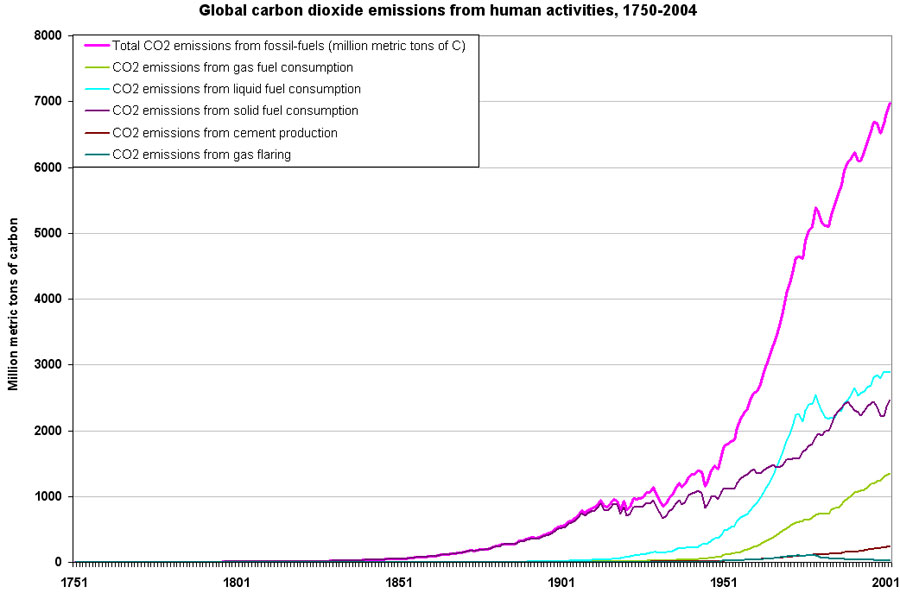
The problem is, the reason why water isn't a serious greenhouse gas is not true in the case for carbon dioxide. Carbon dioxide doesn't condense as easily in the atmosphere and fall to the ground cooling the earth. When it goes up...it just stays up there. It would be one thing if there was a mechanism in place to reprocess the carbon dioxide (besides rainforests which are getting cut down for development purposes), but there isn't, and so we wind up seeing charts like this where carbon dioxide is never really decreasing:


It just happens that there are also charts that look like this:


Now from basic physical understanding, we know that carbon dioxide is a greenhouse gas. Its also not going away, and the more of it there is the warmer the planet will be. It also happens that there is data that seems to support temperatures started getting a little funky around the turn of the 20th century. Scientifically, there isn't a sound way to show this though.

Does anyone know for sure if this trend is because of carbon dioxide (or other greenhouse gases)? NO! A recurring spread by non-scientists and big oil conglomerates is the argument that weather patterns are cyclical, and thus we can't presume anything about our own impact. Thats kind of a creepy thought though especially since...can we be 100% certain that humans are contributing to global warming? YES!

We know that carbon dioxide is a greenhouse gas, we are producing more and more greenhouse gases that warm the earth, and so we are definitely causing an impact. We're seeing an impact now. We know what one of the causes of it is. So, it isn't so much that the 2nd chart is influenced by the 1st, its that the 1st chart alone is quite troubling. It's so troubling that some purveyors of crap (who are not surprisingly funded by big oil) do everything they can to muddle the picture. At least some people do their homework, here.

Maybe the solution is to just sue Al Gore. Sigh...

Saturday, February 16, 2008

Science Saturday IV

Can scientists dance?

No.

This is another edition of simple answers for simple questions.*,**,***

*(This isn't to say scientists don't have fun!)
**(The author, JB, is actually an acquaintance of mine. We played Celebrity and ate Korean pancakes together two summers ago in Berlin. He's a real swell guy.)
***(I acknowledge this post is a blatant rip-off of some by Atrios, but he just as well may regularly rip off other people by doing posts like this.)

Saturday, February 09, 2008

Science Saturday writer's block edition

Anyone feel like collaborating on a group investment of bio-domes off the great barrier reef?

Saturday, February 02, 2008

Science Saturday III - fuels


Lots of oil and natural gas has been found in the deep oceans.

All natural gas burns cleanly, meaning that the only expected products from natural gas burning are naturally occurring molecules. Energy obtained from natural gas is "greener" than that from coal (which contains sulfur that burns into sulfur dioxide - a component of acid rain) and oil (which burns so rapidly that toxic carbon monoxide is usually formed as a biproduct). Nature has mechanisms to convert CO2 back to O2 with photosynthesis, so natural gas is a means to fuel the planet for many decades until more sustainable and renewable energy sources can be developed. The only problem that exists however, as the 10-key princess will inform you, is economics.

Natural gas (methane) is a gas, and gases are voluminous and expensive to transport. Oil and coal are not, and so they are much more economical to transport. However, it is possible to break one chemical bond in methane (this is called "C-H activation"), and put the remaining molecule onto a metal atom (this is called "functionalization"). Once functionalized, there are processes to replace the metal atom (M) with a hydroxide (OH) to form methanol (the alcohol that makes you blind if you drink it, but an easily transportable liquid!). This is trickier than it looks. Methane is relatively inert, and the energy required to break one C-H bond in methane almost the same amount of energy required to break all of the C-H bonds causing it to burn up. Furthermore, it seems that the fine-tuned experiments that do activation well (breaking only one C-H bond) have great difficulty with functionalization.


If anyone reading this happens to figure this problem out you'll probably win a Nobel Prize the year you do...

Saturday, January 26, 2008

Snowball Earth

It's Science Saturday again!

This is actually a very controversial topic in geology circles. (In fact, I know a lovely lady off the coast of Tasmania right now digging for these carbonate structures at the bottom of the ocean floor.) This article relates to a controversial theory called the Snowball Earth theory for global climate from millions of years ago. (Sorry, I'm not talking about controversial modern day global warming today...) This theory assumes that the earth's climate is always in a delicate equilibrium. (This is a reasonable claim seeing that entire polar ice caps can melt in the period of a hundred years when the average global temperature only changes by less than 2 degrees farenheit).

Assuming you don't embrace the history of the friendly (but moronic) folks at Conservapedia, a lot of scientific research has been done to estimate the earth's climate dating back many many millions of years. Earth's temperatures are found through isotope studies of calcium carbonates (fossils).

Now, a brief chemistry class:
All materials on earth are molecules made up of atoms, including you and me and fossils. Crudely speaking, atoms in a molecules behave like balls strung together on networks of springs. These atoms (balls) stay attached in their networks of springs (chemical bonds) to form big nets of balls and springs (molecules).

Quantum mechanics tells us that these balls are always bouncing and vibrating slightly in their springs; they are never completely at rest (as opposed to classical mechanics, the physical laws that govern the world we live in, which says all objects will eventually stop moving once it comes to rest). When temperatures increase, the heat of the environment turns into energy, and that extra energy makes the balls bounce and vibrate more vigorously (just like heating a pot of water eventually makes water boil). However, these balls always stay attached to their springs until something hits the balls with so much force that a spring breaks (like cracking something when it gets smacked), or until the balls absorb so much energy that the vibrations alone break a spring (like when something melts). Lets ignore the smacking aspect and only think about temperatures.

When temperatures are hot, the energy from heat causes balls to bounce in their springs because energy makes balls bounce. When temperatures are cold, the balls only bounce in their springs minimally, because a lack of energy means balls can't bounce. HEAVY balls (even if they are the same size) bounce less than LIGHT balls, because more energy is needed to make heavy balls bounce compared to light balls. Thus, clusters of heavy balls bounce very little compared to clusters of light balls. It turns out that heavy balls are quite rare, but they appear in molecules at very predictable rates. For instance, if I had 100 of a particular kind of light balls, nature tells me that I can safely guess that 1 or 2 of those 100 are heavy, but not any more or any less. Furthermore, these heavy balls have special characteristics that allow us to seem them easily. These heavy balls are called isotopes.

Knowing this, hot babes like my friend can figure out how cold or how warm regions of the earth were as far as millions of years ago. They simply collect old fossils from different parts of the world and then figure out how old the fossils are through radioactive dating methods. By analyzing the atoms in the fossils (the balls in the networks of springs), they look for all the heavy atoms (isotopes) in the fossil. Once found, they look at where the heavy atoms are with respect to each other. If a lot of isotopes are found very close to each other, it means nature at that time must have been cold. This is because having heavy atoms together means nature at that time wanted minimally bouncing balls, and that happens when there wasn't much heat making balls bounce. If the isotopes are all far away from each other, then the temperature must have been warm, because nature at the time could afford to spread out the heavy balls making all the molecules overall more bouncy. Therefore, we can estimate temperatures of the planet.

How cool is that?

Saturday, January 19, 2008

Science Saturday

Yes indeed, its Science Saturday!!! (in some parts of the world anyway...)

Save the day for reading articles or stories with a science slant.

First off, M&M's!